The “Brownfield Revolution” – Air Cargo’s Next Big Move?
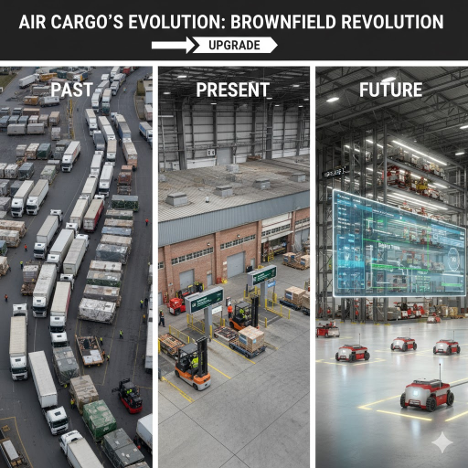
Satellite images of ports don’t lie. Trucks queued up outside the cargo terminal, idling for hours. ULDs stacked and waiting for a breakdown that’s already behind schedule. Hurry up and wait – which really translates to hurry up and waste money.
Congestion has been a perennial roadblock to port efficiency going as far back as amphorae of olive oil and watch-capped longshoremen with billhooks. We’ve blamed e-commerce, labor shortages, and aging infrastructure. We’ve blamed regulation and lack of innovation. For just as long, the obvious solution has always seemed to be to build a bigger, newer, shinier facility. All we have to do is start from scratch, perfectly and all the supply chain bottlenecks evaporate.
The only problem with this approach is that the global supply chain doesn’t come with a pause button.
Today, the conversation is about building smarter.
Welcome to the Brownfield Revolution.
This isn’t just a new coat of paint and a software update. It’s a fundamental shift in thinking. A “brownfield” project isn’t about starting from scratch on a patch of empty land. It’s about looking at the constrained, aging, and operationally complex terminals we already have and cleverly retrofitting them
It’s an industrial evolution within our existing infrastructure, powered by automation and well integrated technology.
How to modernize cargo facilities when you can’t afford to stop?
The “revolution” isn’t about building shiny new terminals. It’s about performing open-heart surgery on existing, aging ones while they are still operating.
Brownfield vs. Greenfield
To understand the revolution, you first have to understand the terms.
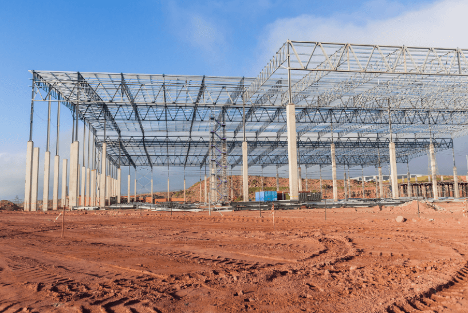
- 🟢 Greenfield: This is the “dream scenario.” Choose the perfect empty plot of land (a “green field”) and build a perfect, state-of-the-art, fully automated terminal from scratch. With no constraints, the perfect facility arrives. The problem? It is prohibitively expensive, takes 5-10 years, and is impossible for most of today’s major ports and airports, which are constrained by the cities around them.
🟤 Brownfield: This is the “real-world scenario.” You take your existing, 40-year-old cargo terminal (a “brown field”)—with its low ceilings, oddly-placed columns, and confusing mix of old and new IT systems—and you strategically retrofit, upgrade, and automate it into sections.
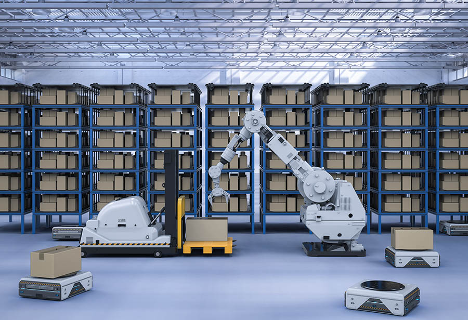
The so-called Brownfield Revolution is the widespread industry shift away from the greenfield dream and toward the complex, messy, but necessary reality of in situ modernization.
Why is Air Cargo Changing Now?
The pressure to modernize has become a breaking-point issue. Manual processes that worked in the 1990s are failing completely.
- The E-commerce Tsunami: This is the #1 driver. E-commerce doesn’t move in neat, stackable pallets. It moves as a chaotic, high-volume flood of small, irregularly shaped parcels. Manual sorting and handling simply cannot keep up, leading to massive bottlenecks.
- Land & Labor Scarcity: You can’t just “build a bigger terminal.” Most major airports (like LAX, JFK, Frankfurt) and seaports (like Los Angeles and Rotterdam) are hemmed in by cities. There is no more land. At the same time, a shrinking labor pool means you can’t just hire more people to throw at the problem.
- The Speed Imperative: Shippers like Amazon, and in turn their customers, now demand 24-hour speed and 100% transparency. An “unknown” or “delayed” scan for a container or ULD (Unit Load Device) is no longer acceptable.
- Cost & Time: A multi-billion dollar greenfield project is a massive capital risk. A phased, $50 million brownfield upgrade to your ASRS (Automated Storage and Retrieval System) can provide an ROI in 2-3 years, not 10.
The Core Challenge: “Open-Heart Surgery”
The main challenge of a brownfield project is keeping the terminal operating 24/7.
For example, we can’t shut down Frankfurt’s cargo hub for a year just to install new racks. What we do instead comes with massive challenges:
- Physical Constraints: How do you fit a 100-foot-tall automated crane in a building with a 30-foot ceiling? How do your new robots navigate a floor that is cracked and uneven?
- IT Integration: This is the hidden iceberg. How do you make your brand-new robotic system “talk” to your 20-year-old Warehouse Management System (WMS) or Terminal Operating System (TOS), which were built by different companies and run on different code?
- Phased Rollout: You have to break the project into dozens of small, manageable phases. This means you will, for a time, be running a “hybrid” terminal—part manual, part automated—which is an operational nightmare to manage.
- Non-Uniform Cargo: An Amazon fulfillment center is designed for small, uniform boxes. An air cargo terminal has to handle a 15-foot-long pallet of industrial machinery, a temperature-sensitive ULD of pharmaceuticals, and a net of loose e-commerce bags—all at the same time.
Stay tuned for PART II where we examine the practical implementation of the Brownfield revolution.
The absolute best way to stay up to date with the important developments in air cargo is to come to the AirCargo Conference in magical Orlando, Florida Feb 15-17. Find out more here.
