How It’s Possible – Implementing the Revolution
Continuing our exploration of the Air Cargo Supply Chain’s Brownfield Revolution, in this post we’ll explore how to modernize cargo facilities when you can’t afford to stop.
The “revolution” isn’t about building shiny new terminals. It’s about performing open-heart surgery on existing, aging facilities while they are still operating.
New technologies deliver new feasibility. We’ve reached a critical juncture where modern tech delivers flexible and modular outcomes.
- The New ASRS (Automated Storage & Retrieval): Instead of one giant crane, new systems use fleets of lightweight robots.
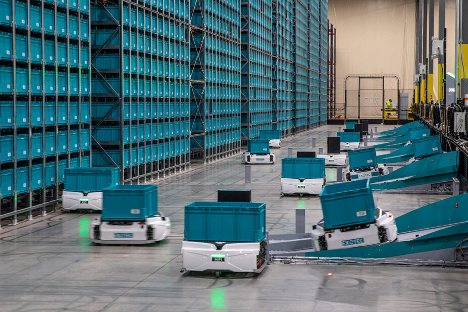
- Old Way: A massive, 10-ton crane on a fixed rail that required a super-flat, reinforced concrete floor.
- Brownfield Way: Modular, lightweight systems (like Exotec’s Skypod) use robots that weigh 300 lbs. They can run on an existing, imperfect warehouse floor with minimal remediation, saving millions.
The New Robots (AMRs vs. AGVs): This is a critical distinction.
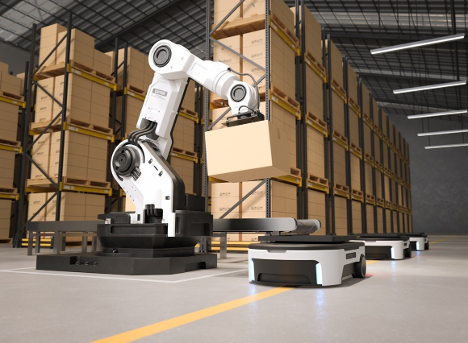
- AGVs (Automated Guided Vehicles) are “dumb.” They follow fixed paths, like magnetic tape on the floor. If a forklift parks on their path, they stop and wait, crippling the operation.
- AMRs (Autonomous Mobile Robots) are “smart.” They use LiDAR and AI to build a map of the facility. If a forklift is in their way, they will navigate around it, just like a human would. This flexibility is essential for a chaotic brownfield environment.
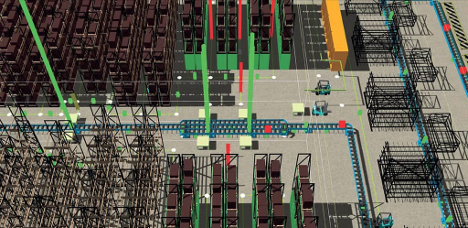
- The Digital Twin & Integration Software: This is the “glue.” Before touching a single piece of steel, companies build a “Digital Twin”—a one-to-one virtual model of the terminal. They can then simulate the entire automation plan, find bottlenecks, and prove it works. This software is also the “translator” that allows the new robots to talk to the old legacy IT systems.
Real-Time Logistics Transformation in Action
This isn’t theory; it’s happening at the world’s biggest hubs.
- Air Cargo: Lufthansa Cargo (Frankfurt Hub) Lufthansa is in the middle of a €600 million “LCCevolution” project to modernize its main hub. They call it “open-heart surgery.” They are demolishing old warehouse sections in phases and replacing them with a new 131-foot-tall high-bay warehouse (ASRS) and a new, multi-story material flow system. This separates cargo and reduces the “traffic jams of forklifts” on the main floor, all while handling 80% of their global cargo.
- Seaport: Port of Rotterdam (Hutchison/MSC) This is one of the most complex brownfield projects in the world. They are taking two separate terminals—one manned and one already automated with older tech—and merging them into a single, next-generation “mega-terminal.” They are doing this in stages, scheduled to finish in 2032, all while ships continue to be loaded and unloaded 24/7. It’s a textbook example of replacing old automation (AGVs) with newer, more flexible automated shuttle carriers.
- Seaport: Port of Los Angeles (TraPac) TraPac converted its entire terminal from a manual operation to one of the most automated in North America. They had to design a unique system of Automated Stacking Cranes and robotic “AutoShuttles” that could navigate their non-rectangular terminal and feed containers directly to their on-dock rail system—a challenge unique to U.S. ports.
From Mess to Masterpiece: The Brownfield Automation Toolkit
For a long time, the thinking was that you couldn’t fit 21st-century automation into a 20th-century building. The columns were in the wrong place. The ceilings were too low. The layout was all wrong. The new generation of automation is flexible, modular, and intelligent. It’s designed for the chaos of a brownfield environment, not in spite of it.

Here’s what we’re seeing deployed right now:
- Smarter Gates, Faster Landside: The truck queue is the first bottleneck. The fix? Automated truck slot booking. Forwarders book a digital window, and Optical Character Recognition (OCR) cameras scan the truck’s license plate and container number on arrival. The system knows who they are, what they’re carrying, and where it needs to go before the driver even unbuckles.
- The Rise of Robotics: Inside the terminal, Autonomous Mobile Robots (AMRs) and Automated Guided Vehicles (AGVs) are the new workhorses. Unlike fixed conveyor systems, these robots navigate around obstacles, people, and other forklifts. They are perfect for the “brownfield” environment, moving ULDs and pallets from the breakdown area to the warehouse without a fixed track.
- Going Vertical with ASRS: The terminal’s footprint is fixed, but its volume isn’t. Automated Storage and Retrieval Systems (ASRS) are robotic cranes that can store cargo 10 stories high, in aisles just inches apart. This is the single biggest “brownfield” play: multiplying your existing square footage by building up, not out.
- The Digital Twin: You can’t test-drive a new layout in a live terminal. But you can with a Digital Twin. This is a one-to-one virtual model of your facility. Before buying a single robot, operators can simulate the entire cargo flow, identify new bottlenecks, and prove the ROI of an automation upgrade—all without moving a single box.
The Future Isn’t a New Airport, It’s a Smarter One
The “greenfield” dream of a perfect, fully automated mega-terminal built from scratch is enticing. But it’s also slow, colossally expensive, and doesn’t solve our problems today.
The Brownfield Revolution is the answer for the here and now.
It’s realistic. It’s cost-effective. It provides incremental gains that add up to a massive operational shift. It recognizes that our greatest assets are the facilities we already own, in the strategic locations we already control.
AirCargo Conference partner the Airforwarders Association (AfA), in partnership with the National Customs Brokers & Forwarders Association of America (NCBFAA), successfully advocated for a Government Accountability Office (GAO) study confirming that outdated airport cargo infrastructure drives up costs and inefficiencies.
Building on this validation, AfA will launch a nationwide outreach initiative in 2026 to identify and prioritize airport cargo-area improvements. Working with airports, members, and federal partners, AfA aims to secure targeted investments that reduce truck wait times and strengthen the U.S. air cargo supply chain.
The future of air cargo isn’t about abandoning our old infrastructure. It’s about having the courage to teach our old warehouses new tricks. The revolution is already underway. The only question is whether you’ll be leading it or getting left behind in the queue.
If you missed Part I of the Brownfield Revolution, you can read it here.
The absolute best way to stay up to date with the important developments in air cargo is to come to the AirCargo Conference in magical Orlando, Florida Feb 15-17. Find out more here
